

At The Coppice Primary School, we use wordLAB (formerly known as Sounds & Syllables) as our programme for teaching spelling. WordLAB is a systematic approach to teaching spelling that teaches children how English words are actually built — their sounds, their meaningful parts and their history. WordLAB teaches all three of these things, in plain terms that the children can apply for themselves.
WordLAB gives children two routines that work on any word in English — teaching children to take a word apart by its sound (phonology) and its units of meaning (morphology). They are taught how an English word is constructed and given fixed routines for taking one apart. Units are built on phonology (sound) or on morphology (meaning), and each has its own analysis, own notation and own routines.
In phonology units, words are broken down into syllables, and syllables are broken down into sounds.
Each sound is matched to its spelling, one syllable at a time, so a long word never has to be held whole in a child’s head. Reduced vowels and elisions — the parts of a word for which the spelling is unclear in ordinary speech — are marked, because that is exactly where errors are made.
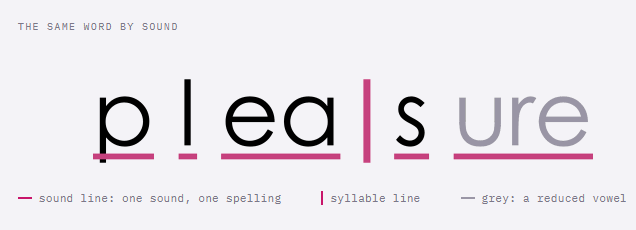
In the example above, a child would:
1 say it in a spelling voice
2 snip it into syllables
3 spell it one syllable at a time
4 think it to understand why
5 link it to similar words
The teacher says the word in a spelling voice and the class repeats it; syllables are counted on fingers and marked; the word is spelled one syllable at a time. Every child writes every step on a whiteboard, so nobody sits and watches.
In morphology units, words are broken into the parts that carry meaning.
Words are broken down into roots, prefixes and suffixes. Swap, drop and double patterns for adding suffixes on are learned and applied deliberately rather than guessed at. In our notation, roots are marked in bold, affixes in light and the letters that carry no meaning in grey. Latin and Greek roots are introduced from Year 4, so spelling and vocabulary grow together.
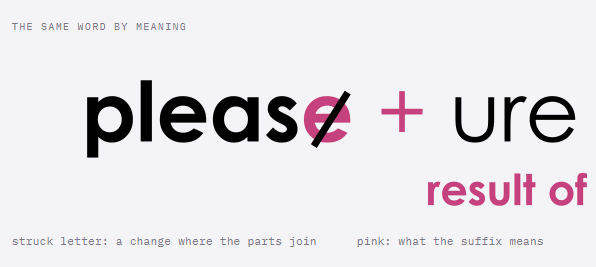
In the example above:
1 write morphemes
2 apply affixing patterns
3 calculate final spelling
4 write glosses
5 explain the meaning
Words are built from their parts, with every affixing change made explicit — which is where a large share of suffix errors comes from in the first place.
For both phonology and morphology units, the pattern is studied, then taught to the whole class, then practised in small steps through familiar practice activities each day until the process is fluent, and finally retrieved from memory.
More information about wordLAB is available at https://jwed.co.uk/spelling/