
The 2014 National Curriculum sets out the programmes of study and attainment targets for all subjects that are to be taught in a Primary School. Schools are given the autonomy to design the way they teach the curriculum.
To view the different documents related to our curriculum, please click on the buttons below:
At The Coppice Primary School, we believe that art nurtures imagination, creativity and confidence, enabling children to express themselves and communicate ideas in powerful, visual ways. Through exploring a wide range of artists, techniques and materials, children develop their ability to observe, experiment and reflect. We place great value on the artistic process over the outcome, ensuring that pupils feel safe to explore ideas, take risks and make mistakes, knowing that there are no ‘wrong answers’ in art. We aim to equip every child with the skills and freedom to create, while fostering an appreciation of how art enriches cultures, communities and the world around us.
The following documents explain the details behind our Art Curriculum;


At the Coppice Primary School, we recognise that technology plays an important role in children’s lives. Our pupils use a range of technologies and access the internet both at home and at school. For this reason, we must support them in learning how to use technology safely, responsibly and creatively.
Through the teaching of computing, our pupils develop an understanding of how technology works, not just how to use it. They learn to solve problems, think logically and create their own digital content, such as simple programs and animations. Pupils also begin to understand how computers collect, store and use information. These skills support learning across the curriculum and help prepare children for the increasingly digital world in which they are growing up.
Online safety is an integral part of our computing curriculum. Children need to understand how to protect their personal information as well as behave kindly and responsibly online, and know what to do if something online makes them feel worried or uncomfortable.
By teaching computing and online safety, Coppice Primary School aims to help children become confident, responsible and thoughtful users of technology.
The following documents explain the details around our Computing Curriculum;
Design and Technology at The Coppice inspires pupils to be creative problem-solvers, working individually and as part of a team. Drawing on the aims of the Primary National Curriculum, children design and make purposeful, functional and appealing products for themselves and others, based on design briefs. They explore and evaluate existing products, develop their own ideas and apply subject knowledge from Maths, Science, Computing and Art. Pupils learn to use a range of tools, materials and techniques safely and confidently. Through practical tasks, children develop technical knowledge, creativity, resilience and an understanding of how Design and Technology shapes the world around them.
The following documents explain the details behind our Design and Technology Curriculum;


We believe that reading is the ‘master skill’ that enables and enhances every other subject. As such, reading is embedded across the curriculum through the regular reading and discussion of texts (including teachers reading aloud) and through purposeful text selection, as well as being taught as a subject discipline in its own right through ‘Reading for Life’ (R4L) sessions.
Learning to read requires the development of two increasingly integrated competencies that underpin reading: word recognition (the ability to accurately identify words) and language comprehension (the ability to construct meaning from those words). Word recognition is based on a pupil’s knowledge of the correspondences between phonemes and graphemes in English orthography and their related phonemic skills. More information about this can be found on our phonics information page.
Phonics provides the decoding knowledge and habits that allow them to begin their journey toward reading fluency, which is a prerequisite for the comprehension that is the purpose of all reading. Once children have started this journey, our approach to reading lessons includes three core components: plenty of decoding practice to build fluency, vast amounts of experience with written language, and meaningful text discussions.
Comprehension of any text relies upon children’s knowledge of written language and the world to which it relates. As such, we treat reading lessons as a knowledge-based endeavour, supported by the explicit teaching of a handful of strategies that help children tune in to their role in making sense of a text. You can find more details about our approach and the rationale for it below:
Through our whole-class guided reading lessons, we ensure children encounter high-quality and diverse literature that enables them to build experience with increasingly complex texts, encounter new knowledge, gain new language, including vocabulary, and develop their fluency.
We want the texts our children encounter to be challenging. As such, the texts chosen for R4L lessons tend to be pitched above the children’s independent reading ability, but within the range of the children’s understanding when scaffolded by a teacher.
The lexile level of text is considered, but this can be misleading, so it is not the main metric we use to judge the challenge of a text. Instead, we select a text based on its ‘text potential’ (Tennent et al, 2016), considering the challenges and opportunities that the text lends itself to.
As well as ‘text potential’, we have considered how ambitious and rich our curriculum is by evaluating it through the ‘five plagues of a developing reader’ outlined in Doug Lemov’s Reading Reconsidered. Through our curriculum, we scaffold children’s developing understanding of ‘the five plagues’ and use them as tools for building resilient, thoughtful readers who are well-prepared for sophisticated reading in their primary school life and beyond.
Furthermore, our curriculum is an ever-evolving document. We constantly evaluate and update our reading spine, particularly considering the ways that it not only supports high-quality literacy outcomes but also plays a vital role in developing inclusive, reflective, and socially aware young citizens.
When making new curriculum choices, we consider Dr Rudine Sims Bishop's vision of books as ‘mirrors, windows and sliding doors’, so that our reading spine provides representation of our children’s own lives, cultures and emotions, allows children to encounter and celebrate difference and diversity, and encourages deep engagement and perspective-taking.
While we are confident that our reading spine is strong in its text potential, its ability to develop increasingly sophisticated reading habits, and its ability to develop empathetic and socially conscious readers, we know that a broad reading ‘diet’ is crucial to our children’s future success. Because of this, we do not interact with our class novel in every guided reading session. In other guided reading sessions, children engage with other texts, such as other novels, picture books, nonfiction texts, poetry and songs. The number of sessions per week at which this happens is at the discretion of the teachers in that year group team. The texts studied can be used to achieve different aims:
Through evidence-informed lesson structures and strategies and creating an ambitious and coherent reading curriculum, we believe we make it more likely Coppice children will grow into capable, confident readers who understand their own reading preferences and recognise the individual and social aspects of interpreting texts.
The following documents explain the details behind our Reading Curriculum:
At the Coppice, we teach writing through a progressively sequenced writing curriculum developed by ESSENTIAL WRITING, from Reception through to Year 6. This is built upon the principles of writing for an authentic purpose and audience at its core. Learning revolves around stimulating texts that cover a range of genres, cultures, and authors.
Each year group’s set of units use diverse and high-quality literature as good examples of writing craft in order to help to motivate or inspire children to write.
ESSENTIAL WRITING is fully aligned with the National Curriculum English programmes of study for Key Stages 1 and 2 and includes writing composition, vocabulary, grammar & punctuation for each year group.
Each writing unit is progressively structured and centered around the different writing purposes: to entertain; to inform; to persuade and to discuss. The writing purposes are also progressively sequenced across the school.
In ESSENTIAL WRITING lessons, the stages of the writing process are given dedicated teaching time to enable all children to behave as writers. They learn about the vital stages of writing and, right from the outset in key stage one, they are given time to collect their ideas, plan and compose their writing orally before writing.
Children are given regular opportunities to share their writing by reading and re-reading it aloud. Children regularly discuss what they have written with their teacher and their peers to ensure their meaning is clear.
They are taught to proofread corrections in spelling, grammar and punctuation so that their readers can follow their writing with clarity.
Vitally, within all writing units, the children are given time to publish their writing to share it and celebrate their success with their intended audience.
The Coppice Primary and Nursery School's Geography curriculum aims to inspire pupils to become curious and explorative thinkers with a diverse knowledge of the world, its people, places and environments and its physical and human processes. We also want our children to consider how we, as humans, interact with the landscapes in which we live, including locally. In other words, we want our children to think like Geographers. We want pupils to develop the confidence to question and observe places, measure and record necessary data in various ways, and analyse and present their findings. Through our curriculum, we aim to build an awareness of how Geography shapes our lives at multiple scales and over time. We hope to encourage pupils to become resourceful, active citizens who will have the skills to contribute to and improve the world around them.
Our curriculum encourages:
The following documents explain the details behind our Geography Curriculum;


At The Coppice Primary School, History helps children understand who they are and how the world they live in has been shaped by the past. By exploring significant people, events and periods from Britain and beyond, pupils develop a clear sense of chronology and an appreciation of how life has changed over time.
Building on the aims of the Primary National Curriculum, our history curriculum is designed to spark curiosity and a love of learning about the past. Children build a secure understanding of key periods from prehistory to the present day, making connections between different eras and the modern world. Through careful inquiry, they learn to ask questions, examine evidence and think critically about cause, consequence and historical interpretations, developing the skills of an historian.
Mathematics is important in everyday life, and here at The Coppice Primary School, we want our children to have both a secure understanding of mathematical content and the ability to solve problems, reason, think logically and work systematically and accurately. The Primary National Curriculum for Mathematics outlines the mathematics that needs to be taught, and to do this, we use an approach known as Teaching for Mastery which supports our pupils in acquiring a deep, secure and adaptable understanding of the subject. To learn more about this approach, please click the link below:
"https://www.ncetm.org.uk/teaching-for-mastery/
We use the White Rose scheme of learning to ensure all the National Curriculum objectives are covered. Teachers use ideas from the ‘White Rose’ scheme and ‘Maths No-Problem’ to plan and teach lessons that are engaging, interactive and meet the needs of the children.
The following documents explain the details behind our Maths Curriculum:
From Year 3 onwards, children at The Coppice Primary School study Spanish as part of the curriculum. As a school, we Pupils develop a strong foundation in key grammar concepts and core vocabulary, learning to introduce ourselves, talk about school, families and pets, and even order food in a restaurant. There is also a strong focus on deepening their knowledge of Spain and Spanish speaking countries, focussing on culture, celebrations and geography. Teaching covers all four language skills — listening, speaking, reading and writing — to ensure well-rounded progress and guarantee that children are in the best position possible to further their language learning at secondary school. In addition, we are proud to be able to offer some of our Year 6 pupils the opportunity to learn the basics of Mandarin, taught by a specialist native speaker from Woodrush High School who we share a site with. Regular zoom calls with our partner school in China are an excellent way to test out their new skills.
If you are looking for additional resources to help your child develop and consolidate their learning or gain a deeper understanding of our curriculum, please refer to the documents listed below:
At The Coppice Primary School, we believe that music enriches our lives and becomes a lasting part of our memories and identities. How many of us can still recall the hymns and songs from our own school days?
The piece of music that instantly takes us back to a particular time, place or feeling? The music we chose ourselves to mark significant moments in our lives?
We want our pupils to experience this same sense of connection and meaning through music.
Through singing, playing instruments, listening and composing, children develop their skills, confidence and creativity. They explore a range of musical styles and traditions while learning to express themselves and work collaboratively. Our aim is for every child to leave primary school with a love of music, a bank of shared musical experiences and the confidence to participate in music throughout their lives.
The following documents explain the details behind our Music Curriculum
Music National Curriculum for Key Stages 1 & 2
At The Coppice, Physical Education plays a vital role in developing confident, healthy and well-rounded children. Our PE provision is designed to ensure that all pupils develop the skills and competence to excel in a broad range of physical activities, remain physically active for sustained periods of time, engage in competitive sport, and develop a lifelong love of healthy, active living.
Through high-quality PE lessons, we focus on developing the whole child. By actively participating in sport and physical activity, pupils learn how to work successfully as part of a team, communicate effectively, demonstrate resilience and build a strong sense of self-worth. These experiences help children to develop both physically and personally, supporting their wellbeing and character development.
We are proud to offer a broad and inclusive curriculum that exposes children to a wide range of traditional and alternative sports. Alongside core activities, pupils have opportunities to experience sports such as New Age Kurling and Mini Muay Thai, ensuring all children can discover activities that inspire and motivate them.
We are proud of our commitment to sporting excellence and inclusion. The Coppice has achieved the School Games Gold Award for the past two consecutive years, reflecting our dedication to high-quality PE and school sport. In addition, our pupils have been County Champions in Year 5/6 Indoor Athletics for four years running, a fantastic achievement that highlights both talent and teamwork..
The following documents explain the details behind our Physical Education Curriculum;


PSHE and RSE provide a vital foundation for the personal development of our children in preparing them for growth and adult life. At The Coppice we use Jigsaw which is an inclusive and well-sequenced whole-school approach that gives our children the knowledge, skills, and understanding they need to lead confident, healthy and independent lives, where children feel a strong sense of belonging.
Jigsaw is a carefully thought-through progressive programme with a full set of attainment descriptors and an assessment process embedded throughout. Please see the link below for a detailed curriculum overview.
PSHE aids the building of a curriculum that is broad and balanced, promoting the spiritual, moral, cultural, mental and physical development of each child.
The RSE focus for our children will be on teaching the skills and knowledge that forms the building blocks of all positive relationships, supporting children from the start of their education to grow into kind, caring adults who have respect for others and know how to keep themselves and others safe.
The following documents explain the details behind our PSHE & RSE Curriculum
At The Coppice Primary School, Religious Education supports children in exploring beliefs, values and ways of life that shape people and communities. We encourage curiosity, respectful discussion and thoughtful reflection as children learn about a range of religions and non-religious worldviews. Through enquiry and exploration, pupils develop understanding, empathy and the ability to think critically about big questions of meaning and purpose. Our Jigsaw RE curriculum plays an important role in nurturing spiritual, moral, social and cultural development, helping children to understand themselves, others and the diverse world in which they live.
Religious Education National Guidance. The following link explains the responsibility that The Coppice, as an academy, has to deliver Religious Education and daily acts of collective worship. It also explains what syllabus options there are for primary academies:
Parents in England have a legal right to withdraw their children from all or part of Religious Education (RE) and collective worship, including in primary and faith schools, under the School Standards and Framework Act 1998. Parents do not need to provide a reason for this request.
Key details regarding the right to withdraw:
At the Coppice, we teach Science through a progressively sequenced Science curriculum based on the Understanding the World: The Natural World strand from the EYFS curriculum and following this, the National Curriculum from Year One to Year Six.
The science curriculum is carefully planned to build on children’s previously taught knowledge, vocabulary and scientific skills and understanding. We begin the science journey in Nursery, where our youngest children have opportunities to engage, explore and discover the world around them. The provision and teaching focuses on the vocabulary and experiences in the children's world. They also go to Forest Rangers weekly to experience the natural world.
We are very fortunate to have our own science lab, ‘The Phiz Lab’. This is a central science-focused learning space that promotes the school's value and commitment to science. All year groups use the Phiz Lab and have access to a vast range of scientific equipment and resources.
Assessment is used to assess what knowledge children have remembered. On-going assessment in lessons enables a teacher to see whether there are gaps in a child’s understanding, in order to provide additional support. It also provides opportunities to identify where a child may excel in a particular area. Teachers provide children with frequent opportunities to revisit both knowledge and concepts.
Children are assessed against curriculum-related expectations. Our curriculum specifies what has been taught and children are assessed as to whether they have met the expected level of understanding.
Opportunities to assess whether knowledge has been retained takes place through questioning and regular retrieval activities. End of unit summary tasks are also used to assess what knowledge children have remembered and their depth of understanding. More formal ‘tests’ are also carried out at key points in the year, including the use of NFER tests which give the children a standardised score in Years One to Six.
Children also have formal assessments at various stages during their time at The Coppice, in line with statutory requirements:
Children’s attainment in Reading, Writing, Maths, Science and Computing is tracked on ‘INSIGHT tracker’. Summative and formative assessments help the teacher to make judgements against the learning objectives that have been taught. Attainment in other subjects is tracked using our own assessment systems.
To explain our assessment approach further, we have created additional documents which can be accessed through these links:

The 2014 National Curriculum sets out the programmes of study and attainment targets for all subjects that are to be taught in a Primary School. Schools are given the autonomy to design the way they teach the curriculum.
Our curriculum ensures that all statutory requirements are met and that pupils receive a broad and balanced education. We have high expectations for all of our pupils and aim to challenge and inspire them whilst also being sensitive to their individual needs and backgrounds.
Our curriculum is designed with the following elements at its core:
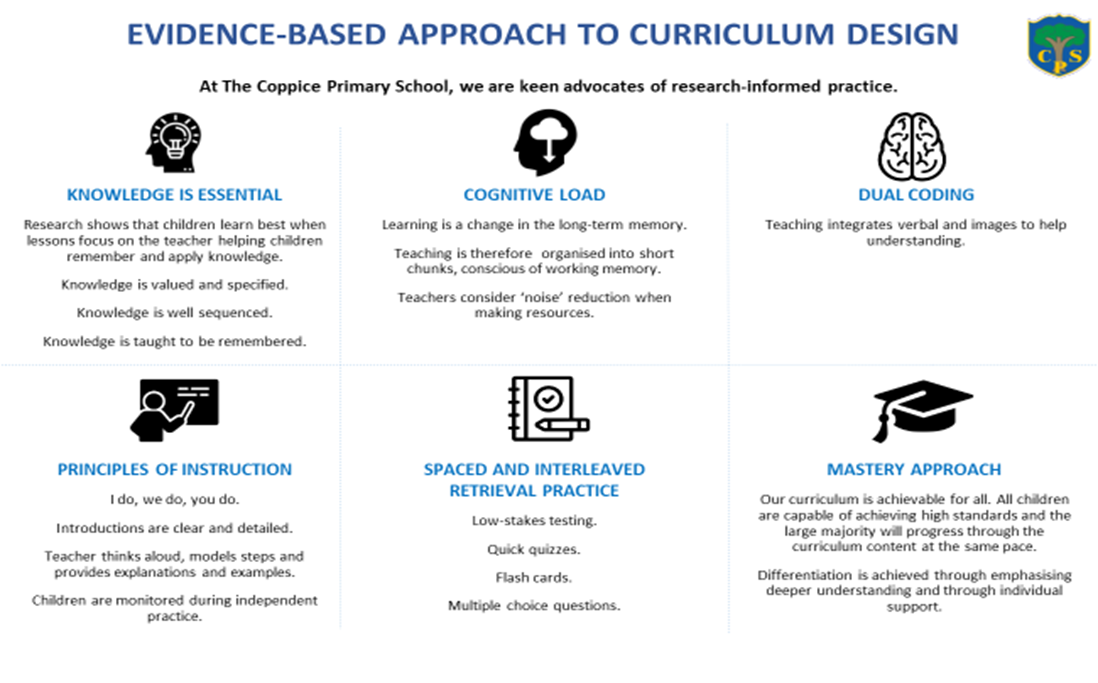
Knowledge: The curriculum progression at The Coppice has been carefully considered: topics have been chosen because of their cultural capital value and relevance to our children’s lives. Our curriculum is sequenced coherently and deliberately, allowing for cumulative knowledge and understanding to be built. Our subject leaders specify the knowledge to be taught in detail in our planning and core ideas are shared with children and families in our knowledge organisers, which are also used as a focal point for retrieval practice.
Concepts: Our subjects are systematically designed around progressive knowledge acquisition and understanding of key concepts. Our curriculum deliberately plans for and draws attention to where links occur both within a subject and between subjects. Having a strong knowledge base enables these links to be more readily identified. Concepts are reinforced, revisited and built upon year on year, cumulatively developing knowledge and deepening understanding.
Reading: At The Coppice, we regard reading as the master skill that makes all other learning possible. As such, we plan for our children to receive a reading-rich education. We have a ‘spine’ of core texts that have been carefully selected to expose children to a wide range of characters, genres, ideas and vocabulary. In addition to class novels and texts used as stimuli in English lessons, Coppice children read throughout the curriculum to improve their knowledge of the world we live in and build their vocabulary. High quality texts that relate to the content or theme of a year group’s topic are carefully selected and used by the teacher in lessons. We also know that the will to read and the skill to read mutually reinforce each other: once our children can read, we ensure they are given time to read for pleasure including weekly use of the school library.
Evidence: Our curriculum is designed to be remembered, not just encountered. Because of this, much of our staff development work aims to increase familiarity with the latest cognitive science research about how children learn and remember. Our goal is for all of our children to remember what they are taught in the long term. To support them in this, our staff consider the limitations of working memory, presenting new learning in small steps with checks for understanding.
Retrieval: Through retrieving previously learnt information, children’s memory is strengthened and they are more likely to remember knowledge in the long term. At The Coppice we are aware of this and use spaced and interleaved retrieval practice quizzes and questioning.
Progress: Progress has been made when there is a change in long term memory. Our curriculum is deliberately planned so that links are made within and across subjects and knowledge is built upon year on year. This doesn’t just include declarative knowledge (knowing that…) but also procedural knowledge (knowing how to…). Skills in each subject are also developed to build upon the knowledge being learnt, particularly in subjects like Art, DT, Music and PE which are designed around technique development as well as subject specific knowledge. Assessments in each subject check that children are retaining knowledge and making progress. Consequently, our well-planned and engaging curriculum ensures that all children are able to make good or better progress, and achieve the high expectations that are set for them.
Support for all: All staff understand the children’s needs. Teaching is designed to overcome any barriers to children’s learning that they may face, in order to make learning accessible to all. They make adaptations to teaching and learning and scaffold learning appropriately. We consider how explanations, demonstrations and slide-design can support learners with poor working memory. We also make reasonable adjustments, where necessary, to both the environment and the resources we provide to support learning. Assessment is ongoing throughout lessons and in the moment adjustments are made where required to best meet the needs of all children.
Enhancements to the curriculum: A wide range of other activities enhance the curriculum. History theme days ensure that children are fully immersed and engaged in learning about the past. In KS2, there is an opportunity for children to learn to play an instrument if they wish to, through specialist teachers. External IT specialists are also used to enhance the IT curriculum, to ensure areas such as computer coding are delivered effectively. Mandarin is also offered to children in Y6 who show a strength in learning languages. They are taught by a Mandarin teacher from the Secondary school and regular links are made with a school in China. Other visitors to the school contribute specialist knowledge and skills, including sporting activities, Restart a Heart, Bike-ability, author visits and Art based projects. Children also have the opportunity to engage in a wide range of extra-curricular activities and trips, including residential visits for Years 5 and 6.
Ultimately, our curriculum is designed to ensure that children know more and remember more, make maximum progress and are able to become the best version of themselves during their time at The Coppice.